
Resources · Middle School
Middle School Resources
Middle School event informationDates, fees, how the day runs and how to register
Introduction
Welcome to the resource page for the 2026 Middle School Ethics Olympiad, for students aged 10 to 14. Everything you need to prepare a team is linked here. It will be particularly useful to anyone new to the Ethics Olympiad, and coaches are welcome to pass this page on to their eth-letes.
New to the format? Watch a recorded Ethics Olympiad heat to see how a heat actually runs:
The Ethics Olympiad has a proven track record of giving teachers and students a creative vehicle for developing skills in communication, critical thinking and respectful discourse, while dealing with important and interesting ethical issues.
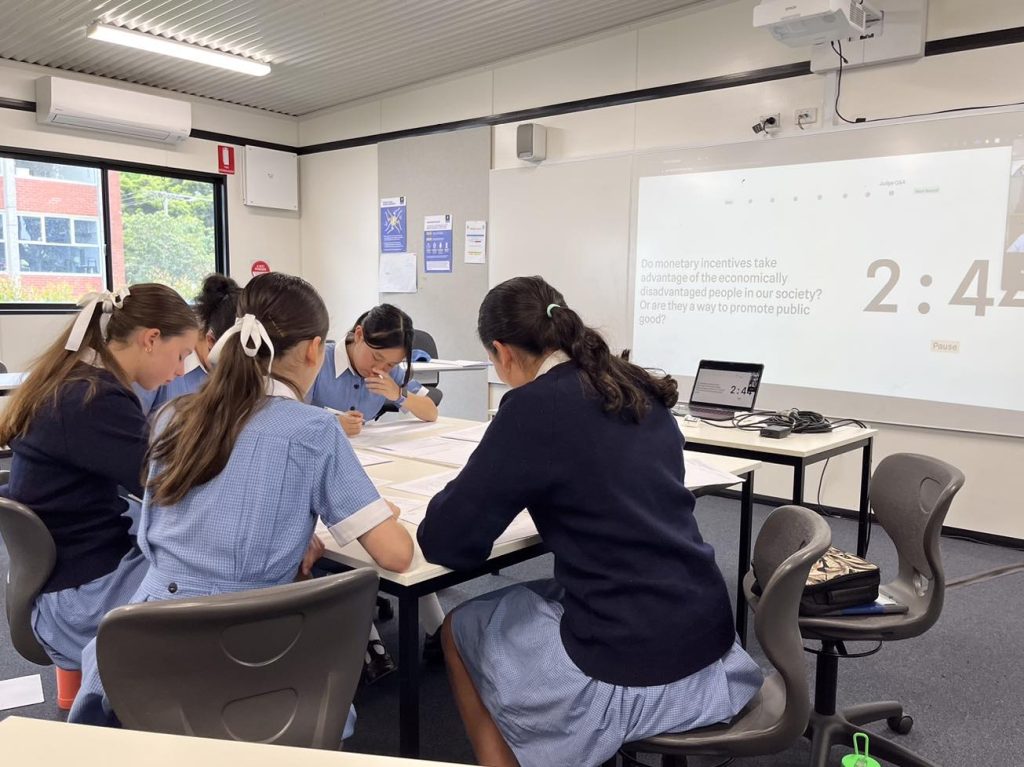
Schools enter five to ten students. We call them “eth-letes” because, like athletes, they are in training for excellence, in their case, excellence in ethical thinking. Unlike a debate, students take the position they actually hold. They work as a team, alongside teams from other schools, to reach the best possible answer to difficult ethical questions.
Across the day every student takes part in four heats, scored against set criteria that reward clear, concise, respectful discourse about interesting ethical cases. Gold, Silver and Bronze medals are awarded to the top three school teams, and Gold and Silver medal-winning schools are invited to represent their region and country at the International Ethics Olympiad final.
Background
The Ethics Olympiad builds on two initiatives: Philosothons in Australasia and Ethics Bowls in the United States. The National High School Ethics Bowl is coordinated by the Parr Centre for Ethics at the University of North Carolina; the National Philosothon is coordinated by the Australian Association of Philosophy.
An Ethics Olympiad is a competitive yet collaborative event in which students analyse and discuss real-life, timely ethical issues. Experience shows that it encourages and promotes ethical awareness, critical thinking skills, civil discourse, international engagement, and an appreciation of diverse points of view.
In 2007 we started a competition in Perth, Western Australia called a Philosothon, involving nine Perth schools. By 2021 more than thirty Western Australian schools and three hundred interstate schools were taking part in annual Philosothons. The first Australasian Philosothon took place in Sydney in 2011, and these events are now hosted annually by the Australian Association of Philosophy. Philosothons also run in the UK.
In the United States, tertiary institutions have run Ethics Bowls annually since 1995. Each state holds a regional Bowl, culminating in the National US Ethics Bowl. The first National High School Ethics Bowl was run at the University of North Carolina in 2013, and each year the top schools from each US state gather there for three days of competition.
Ethics Bowls are different from Philosothons. At an Ethics Bowl or an Ethics Olympiad, a team of five students from the same school works together to present a position in response to a single question given at the start of the event. At a Philosothon, one student from each school sits in a circle and, together with students from other schools, explores possible answers to philosophical questions.
In 2013 a trial linked US and Australian schools by video conference. It was a great success, and the Ethics Olympiad was born. In 2018 we opened the event to Middle School students and in 2021 we hosted the first Junior Schools Ethics Olympiad. In 2019 we ran face-to-face trials in Canberra and Melbourne: a day-long program of three heats and a final, with teachers judging the heats and tertiary specialists judging the finals.
In 2020 all Senior Ethics Olympiads had to be cancelled because of Covid-19, so we ran online trials for member schools instead. Those worked well enough that the Middle School Olympiads moved online in 2021, followed by a final for the Gold and Silver medal-winning schools from each region. We also recruited and trained a judging panel of 25 philosophy majors from universities in Australasia and elsewhere. Since then the model has proved a wonderful success: regional and remote schools take part every year, and we can draw on excellent judges from around the world. 2021 also saw the introduction of Junior School Olympiads and a series of training sessions to help coaches prepare their students.
What is Ethics?
All hospitals and universities have “ethics” committees, many companies have an official ethics code, and lawyers are required to take ethics training. But when academic philosophers use the term “ethics” they are talking about the reason-guided study of what we morally ought to do. That is not to say that doctors, companies and lawyers do not use reason, or do not make decisions about what we morally ought to do. They most certainly do. It means that what makes philosophical ethics distinct is that the ultimate grounding for its conclusions is reason itself, rather than preference, company policy or legal precedent.
Philosophers use reason to form arguments: a series of claims, called premises, intended to logically support another claim, called the conclusion. They construct, share, evaluate and revise these arguments in a collective effort to work out what makes the most sense. No conclusion is beyond revision, and any good philosopher is willing to change their mind on almost any issue, given good enough reason to do so.
Ethics in a Nutshell
Dr Matthew Deaton wrote this book for high school students taking part in the US Ethics Bowl. It refers to the Ethics “Bowl” throughout, but everything in it applies directly to the Ethics Olympiad. If you are unfamiliar with the important ideas in ethics it will help you a great deal, and Dr Deaton has made it freely available, so you are welcome to pass it on to your eth-letes.
Ethics in a Nutshell: Educator EditionDr Matthew Deaton
Audiobook chapters
The full audiobook is one recording; each link below opens it at the right chapter.
- Ch 1: Welcome
- Ch 2: Ethics, Religion & Public Discourse
- Ch 3: Why Ethics Isn’t Ice Cream
- Ch 4: Three Key Distinctions
- Ch 5: The Four Dominant Ethical Theories
- Ch 6: All Things Considered
- Ch 7: Argument by Analogy
- Ch 8: Intuition, Reflection & Coherence
- Ch 9: Conclusion
- Lecture Notes
- More Books by Matt Deaton
- Further Reading
Cases
The case set is released well before the event. Teams are not expected to research the cases, but to prepare well-structured, reasoned answers to the single question asked about each one.
2026 Middle School Ethics Olympiad casesPrintable case set
Training Clinics
We run optional training clinics for students and coaches again in 2026. They are very useful for participating students and coaches: a chance to meet experts in the field and some of the judges taking part in the Ethics Olympiads.
Middle School training clinic information and registrationOn this site
Coaches’ Resource Kit
2026 Middle School Coaches Resource KitScore sheet, rules and a guide for coaches preparing a team
How to be an Ethics Olympiad coachCoaches’ tips
2026 Middle School cases (printable)
Information for parentsA page written for parents and carers: share it directly
Students’ Resources
2026 Middle School Students (Eth-letes) Resource KitScoresheet and other helpful information for students preparing for an Olympiad
2026 Middle School cases (printable)
Video of a heatWatch a full recorded Ethics Olympiad heat
Rules
Teams
- Remember, this is not a debate. Teams can agree with each other’s position. But Team B can raise questions Team A has not yet considered, to take the discussion further.
- Teams consist of no more than five members and no fewer than three.
- Fresh scrap paper is needed at the start of each heat for notes during the match. Pre-prepared notes and materials are not permitted.
- Keep microphones off unless your team is invited to speak by the moderator/judge during your assigned times.
- During private conferences (the two-minute or one-minute conference), students should be in one room with microphones off. Teams spread across multiple locations need a separate online forum for team meetings, used only during the allotted conference times.
- The moderator/judge keeps the official time for each period of the match. Teams may use their own timer, provided it is not a device that stores data or connects to the internet, and provided they do not time the portions of the match when the other team speaks or confers.
- Students do not need to be familiar with ethical theories to take part. They are, however, encouraged to explore positions other than the one they take.
- Teams are urged to outline their presentation as it begins: who will cover which aspects of the case, and why, so the moderator/judge knows what to expect.
- Students are encouraged to read the cases carefully beforehand, along with the linked resources, so they understand the full breadth of each case, settle on their position and make the strongest possible presentation. Teams may use outside research, but should not assume that presenting factual information alone will impress the judges. Reasoning needs to be valid, sound and persuasive, and supported by facts. If a team introduces a specific fact not contained in the case, it should cite the source (for example, “according to a 2011 article in National Geographic…”).
Moderators and judges
- Questions should be directed to teams based on the discussion, not to individuals.
- The moderator/judge may allow a team to finish a sentence once time has expired.
- A visible timer is used. If for some reason it is not working, teams will be given a time notification by the moderator/judge during their presentation. For example “you have two minutes left”, then “time’s up”.
- The moderator/judge controls the room during matches and should address any unacceptable behaviour, including coaches, parents or audience members communicating with team members, verbally or non-verbally, or visibly reacting to them during a match.
- Anyone in the breakout room who intentionally makes distracting noises while a team, judge or moderator has the floor will be asked to step out. Foul, insulting or excessively graphic language, and confrontational behaviour, will not be permitted.
- The moderator/judge can only control noise within the breakout room. If there are outside distractions, it is the moderator/judge, not a coach or a parent, who decides whether the round should be paused.
- Teams must answer the case question during their presentation period. They are scored on how clearly and systematically they address and respond to the question asked.
- Teams are neither penalised nor rewarded for whether one person speaks or everyone contributes. Both approaches are welcome.
- When one team confers or speaks, the other team and any audience members must remain silent, although writing and passing notes is permitted. For example, when Team A is given the case and question they may confer for two minutes and then present for five. During those five minutes Team B may write notes, but must stay silent.
- The decisions of the moderator/judges are final. Heats are totalled at the end and the results published the following day. Where there is a tie, the head judge decides on the highest score in the first heat; if that is still a draw, the highest score in the second heat, and so on.
- Any complaint or challenge to the results should be put in writing to the organisers.
- Results are emailed to supervising teachers and to moderator/judges.